
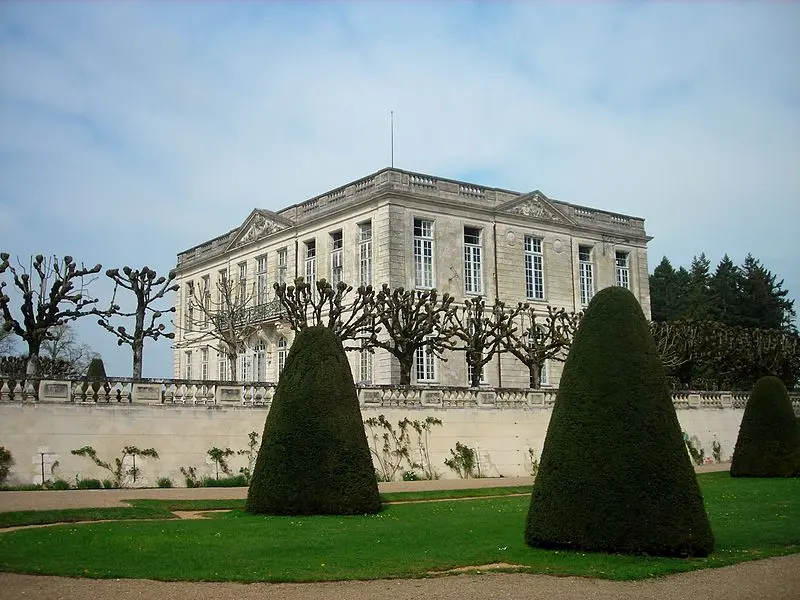


Bouges-le-Château : Bouges Castle
IndreReference
PA00097284
Latitude
47.04240844
Longitude
1.67294871
Address
13 Rue du Château 36110 Bouges-le-Château
Construction era
3e quart 18e siècle;19e siècle;limite 19e siècle 20e siècle
Protection date
2001/09/07 : classé MH
Protection cause
Château, ses dépendances, ses jardins et son parc, y compris les bâtiments et les murs de clôture ainsi que l'allée d'arrivée (cad. E lieudit le Bourg 1, 2, 5, 394 à 397, 496 à 499 ; A lieudit le Parc 18, 20, 21, 94, 95 ; ZA 30, lieudit la Pierre Folle, 31, 37, lieudit l'Epinaise, 38, lieudit les Bulles, 47, lieudit Crève-Coeur, 48, lieudit le Pavillon) : classement par arrêté du 7 septembre 2001
Description
The Château de Bouges was built between 1763 and 1770 for Charles Leblanc de Marnaval, farmer of the Forges de Clavières, near Ardentes (Indre), and administrator of the royal manufacture of châteauroux sheets. Although the architect is not known, the conception has been given without proof to Ange-Jacques Gabriel or a certain Fayeti, whose name is engraved on a balustrade. This castle has testified to the evolutions of the gardens since the end of the 18th century. The gardens that surrounded the house of Charles Leblanc de Marnaval, not very documented, formed a global composition organized around a main axis, with the castle, raised on a terrace surrounded by a balustrade, a hemicycle honor, an entrance gate and a prospect towards a riding driveway through the woods of the domain. The park spread over a large quadrilateral west of the castle. A closed vegetable garden of walls was located south of the farmyard. Around 1840, Antoine-Achille Masson, count of Montalivet, redeveloped the park. Between 1897 and 1909, the landscapers Henri and Achille Duchêne recreated, according to a modern vision, French gardens around the castle and set up the landscaped park for Henri Dufour. From 1917 to 1967, Mr. and Mrs. Viguier made various embellishments of the park, and in the 1950s, they created a flower garden at the site of the old vegetable garden. The interest of the gardens lies in the perfect harmony between their different parts, resulting from varied eras and styles. They illustrate the talent of the Duchêne and great coherence in creation. The castle was bequeathed in 1966 at the National Caisse des Monuments Historiques and sites, which has become the center of national monuments.


