Perpignan : Former Preaching Brothers Convent
Pyrénées-OrientalesReference
PA00104070
Latitude
42.7006
Longitude
2.8989
Address
17 Rue François Rabelais 66000 Perpignan
Construction era
14e siècle
Protection date
1977/05/17 : classé MH
Protection cause
Couvent des Frères Prêcheurs (ancien) , y compris la chapelle Notre-Dame avec ses peintures murales (cad. AD 359) : classement par arrêté du 17 mai 1977
Description
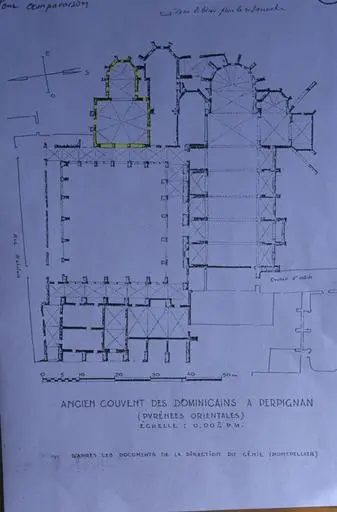
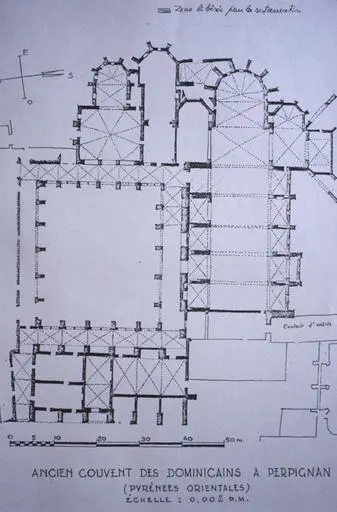
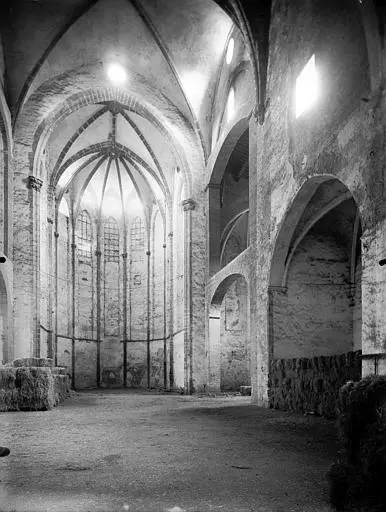
This architectural complex, mainly dated 13th and 14th centuries, also included elements of the 15th, 16th and 18th centuries. The part is of this site is remarkable by its series of five apse and apse aligned next to each other. The chapter room, adjacent to the Saint-Georges chapel, was built in the 14th century, presenting a square plan at the bottom and octagonal at the top, with four tubes connecting the two sections. Its coverage follows the Catalan technique, with as many gables as vaults. The cloister has undergone transformations at different times. Eastern and Western galleries date from the 13th and 14th centuries, while the north and southern galleries, renovated, are based on square brick pillars. Many capitals, columns and ancient bases of these galleries are always present. In the 16th century, the cloister was endowed with a vault in bricks' warheads, supported by marble pants from the 14th century. During the same century, a upper gallery was added, with brick arcades on cylindrical pillars with capitals also in bricks. The old refectory, dating from the 14th-15th centuries, is on the ground floor of the west wing, while the old 14th century dormitory is on the floor of this same wing, covered by a frame resting on eight diaphragm arcs. The Notre-Dame chapel, built under Louis XVI, was once the siege of the Third Order of Saint-Dominique. It consists of a single nave with cradle, flanked by side chapels surmounted by basket -shaped galleries. The building is decorated with fluted pilasters with ionic capitals. The chevet's cul of the bedside is decorated with trompe-l'oeil paintings and wall frescoes dating from the end of the 18th century, which seem to have been modified at the end of the revolutionary period. In the southwest of the church, we can observe the vestiges of the ancient cloister cemimeter of the 13th century.